

TL;DR Almost every guide to Meta ads on a small budget tells you to go broad and let the algorithm work it out. At twenty dollars a day in a country of twenty seven million people, that starves the learning phase and you never get a clean read on anything. We mentored one Australian store owner to do the opposite and concentrate everything, one state instead of a country, dynamic product ads off a properly built catalogue instead of custom creative, and a handful of concepts instead of fifty ads. Seventeen days of ads later it is working, though the conversion rate is still the weak link. Here are the three decisions, the honest numbers, and the rules for when to widen each one.
Table of Contents
- Why Meta ads on a small budget fail by default
- Three decisions, one principle
- What seventeen days of ads actually looked like
- The number that is not good yet
- When to widen each constraint
- The bottom line
- FAQs
- Sources
The advice you will find for running Meta ads on a small budget was written for someone else’s budget. Go broad, trust the algorithm, let it find your buyers.
That works at two hundred dollars a day. At twenty it does not, because the algorithm needs enough conversion events to learn from and a small budget spread across a whole country produces almost none.
We have been mentoring a Western Australian photographer who sells framed and canvas beach prints. He is not a client. He came through a session we run for Gold Coast business owners, migrated himself off WooCommerce to Shopify with our guidance, and started advertising with a budget most agencies would not return a call for.
Why Meta ads on a small budget fail by default
Meta optimises by finding patterns in the conversions you feed it. Few conversions means no pattern, and no pattern means the delivery system is guessing with your money.
Spread a small daily budget across a national audience and you get a thin scattering of impressions across millions of people. Nothing repeats. Nothing compounds. The account never exits learning and you conclude that Meta does not work for you.
The fix is not more budget. Most people do not have more budget. The fix is concentration.
Three decisions, one principle
Every decision below is the same move made three times. Take a small amount of spend and force it into a small enough space that it produces enough events to learn from.
One state, not one country
He advertises in Western Australia only. Not because the rest of Australia would not buy, but because at twenty dollars a day the rest of Australia is a rounding error that dilutes the signal.
Geography is the cheapest concentration lever a small advertiser has. Fewer people, more repeat exposure per person, faster learning, and a read you can actually trust.
It also happens to suit the product. The work is Western Australian coastline, and the people most likely to hang a picture of Scarborough Beach on their wall live near Scarborough Beach.
The catalogue, not custom creative
This is the part that gets skipped. Before a dollar went to Meta, the store was structured properly on Shopify. Clean product titles, correct collections, real product data.
That is not housekeeping. A properly built store is already an ad library. With the catalogue connected, dynamic product ads generated a full creative set from products that already existed. No shoot, no editing, no design cost, nothing to approve.
He was advertising with a complete creative rotation before he had made a single asset. That is the entire reason a twenty dollar a day budget was viable at all.
A few concepts, not fifty ads
The obvious next move once something works is to make more of it. On a small budget that is the fastest way to break it.
Fifty ads at twenty dollars a day gives each ad forty cents. Nothing gets enough delivery to be judged, the signal fragments, and performance goes backwards while you congratulate yourself on testing.
The rule is a small number of genuinely different concepts rather than many variations of one, with a hard cap on how many run at once. Different angle, different format, different framing. Not the same image with a new headline.
What seventeen days of ads actually looked like
Here is the whole trading history, because there is not much of it and hiding that would be dishonest.
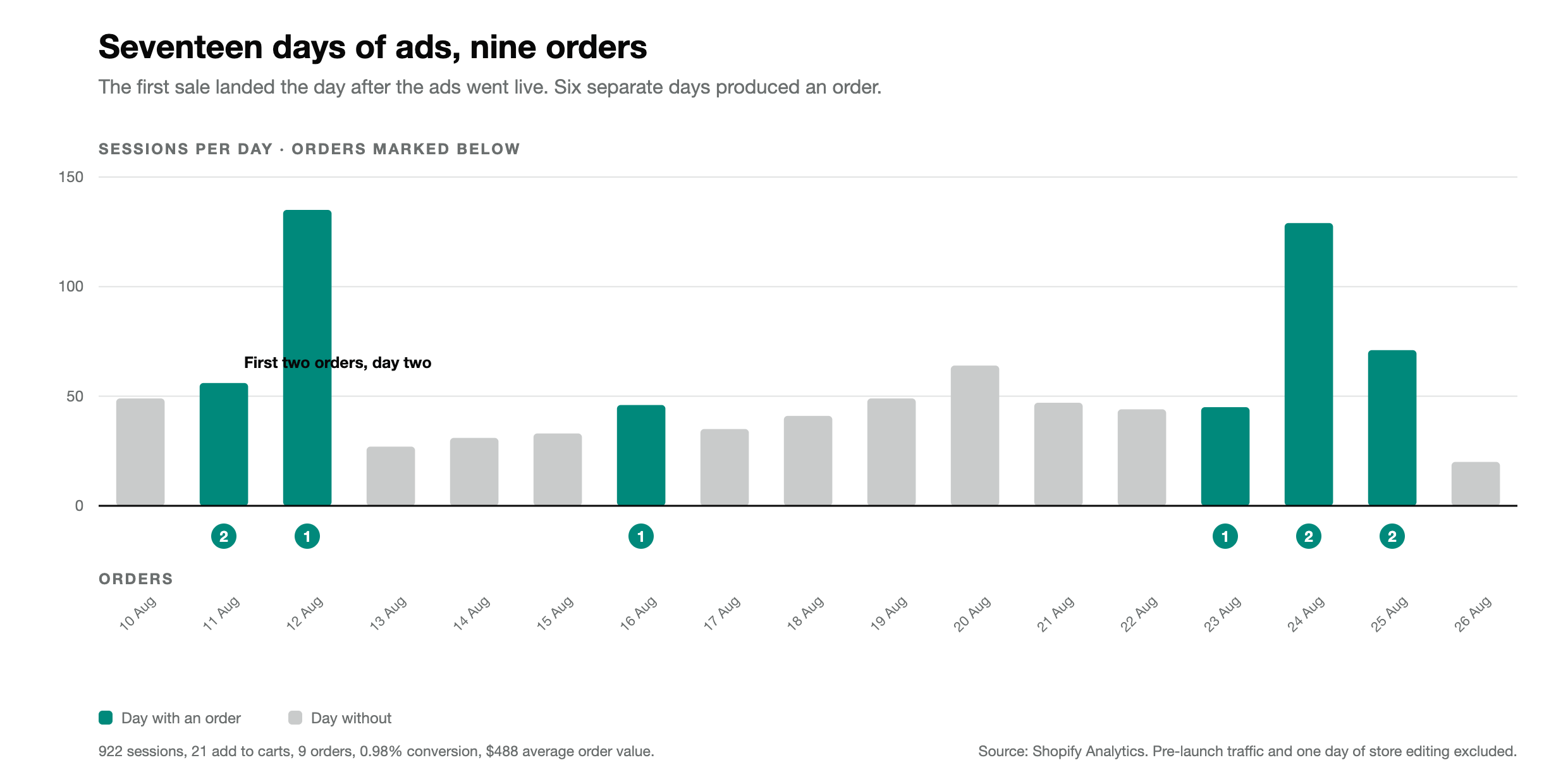
The ads went live on 10 August. The first orders landed the next day. By 26 August the store had done nine orders from 922 sessions of ad period traffic, at an average order value of $488, with spend in the low hundreds.
Two things in that chart matter more than the revenue number.
The first orders arrived the day after the ads went live. That is what concentration buys you. A narrow enough setup produces a readable signal in days rather than weeks, which is the difference between knowing and guessing.
And the orders came on six separate days rather than in one lucky burst. Nine orders is a small sample either way, but nine spread across six days is a more trustworthy one than nine on a single Tuesday.
One note on how those numbers are counted. The store’s analytics show 1,635 sessions across the wider period and we have used 922. The difference is traffic from before the ads went live, plus one day where the owner was editing his own store and generated 458 sessions of himself. Counting those would have reported a 0.42% conversion rate instead of 0.98%. Your own traffic pollutes your own numbers, and on a small sample it does it violently.
The number that is not good yet
It would be easy to write this up as a success story and stop. The data does not support that, so here is the honest version.
The conversion rate is 0.98%. Add to cart is 2.28%. For a considered purchase at a $488 average order value those are not disastrous, but they are not good either, and they are now the constraint.
Eight of the nine orders used a discount code. A first order welcome offer is doing more of the closing than the store is.
The budget was the constraint. It is not any more. Concentration solved the delivery problem, and the next problem is a product page and an offer that convert without a code doing the work. That is where the next month goes.
This is also seventeen days and nine orders. It is a real result and a small sample, and both of those things are true at once. We will know whether it holds when the budget steps up and the sample gets bigger.
When to widen each constraint
Concentration is a starting position, not a religion. Each constraint has a signal that says release it.
| Constraint | Release it when | Release it to |
|---|---|---|
| One state | Frequency climbs while cost per purchase holds, meaning you are running out of fresh people | An adjacent state, not the whole country |
| Catalogue only | The product ads fatigue, which shows as falling click through at steady spend | Two or three distinct concepts, not a batch |
| Few concepts | Each live ad is getting enough weekly purchases to be judged on its own | One new concept at a time |
| Small budget | Cost per purchase is stable across at least two weeks, not one good week | Steps of roughly 20 to 30%, not doubles |
Widen one thing at a time. Widen two and you will not know which one moved the number.
The bottom line
- On a small budget, going broad starves the learning phase
- Geography is the cheapest way to concentrate spend
- A properly built store gives you a free creative library through the catalogue
- More ads on a small budget fragments the signal that was working
- Once delivery works, conversion becomes the constraint, and that is progress
If you are spending a small amount and cannot tell whether it is working, that is usually a concentration problem rather than a budget problem. Happy to look at it with you on a Discovery Call. Relaxed conversation, no pressure, no obligation and no sales pitch. If we would not do it in our own business, we will not recommend it in yours.
FAQs
What is the minimum budget for Meta ads? There is no fixed minimum, but a small budget only works if it is concentrated. Twenty dollars a day aimed at one state and a small set of ads can produce a readable result, while the same amount spread nationally usually cannot.
Should I target broadly or narrowly on a small budget? Narrowly, at least to begin with. Broad targeting needs enough conversion events for the algorithm to find a pattern, and a small budget spread wide does not generate them. Start concentrated and widen when frequency tells you to.
How many ads should I run on a small budget? Few enough that each one gets meaningful delivery. Divide your daily budget by the number of live ads. If the answer is under a couple of dollars each, you are testing nothing and fragmenting your signal.
Do dynamic product ads work for a new store? Yes, and they are often the fastest way to start. If your catalogue is clean and connected, dynamic product ads build a creative rotation from products you already have, which removes the cost and delay of producing assets before you know what sells.
How long before I know if Meta ads are working? Judge the first fortnight on click cost, add to cart rate and cost per purchase rather than on revenue. Revenue on a small budget is too lumpy to read, and a single good day tells you nothing.
Sources
- First-party Shopify reporting from an Australian wall art and print store, 10 to 26 August 2026, the window the ads ran, used with permission and reported unnamed. Figures are sessions, add to carts, orders, conversion rate, average order value and discount code usage as shown in Shopify Analytics. Sessions from before the ads went live, and one day of store editing by the owner, are excluded.
- Ad spend, targeting and budget figures come from the Meta Ads account and Google Analytics, cross referenced against the Shopify order data.


